Why Do You Think Greek Myth Uses the Model of the Human Family to Depict the Gods?
Greek mythology was used every bit a means to explicate the surroundings in which humankind lived, the natural phenomena they witnessed and the passing of fourth dimension through the days, months, and seasons. Greek myths were also intricately continued to religion and explained the origin and lives of the gods, where humanity had come from and where information technology was going subsequently death.
Greek myths gave faces and characters to the gods of the Greek organized religion but they also gave people helpful applied communication on the all-time way to atomic number 82 a happy life. Another purpose of myths was to re-tell historical events so that people could maintain contact with their ancestors, the wars they fought, and the places they explored.
The Telling of Myths
In modernistic usage the term 'myth' perhaps has negative connotations suggesting a lack of authenticity and reliability. However, it should not be assumed that myths were whole-heartedly believed in nor should it be assumed that the Greeks were wholly sceptical of them. Probably, the Greek myths, as with any religious or non-written sources, were believed past some and discounted by others. Myths were certainly used for religious and educational purposes but also may well have had a simple aesthetic part of entertainment. What is certain is that the myths were both familiar and popular with a wide department of Greek society through their common representation in art, whether that be sculpture on public buildings or scenes painted on pottery.
Without wide-spread literacy, the passing on of myths was first done orally, probably by Minoan and Mycenaean bards from the 18th century BCE onwards. This of course allows for the possibility that with each re-telling of a particular myth, it is embellished and improved upon to increase audience interest or comprise local events and prejudices. Even so, this also is a mod interpretation, for it is likewise possible that the telling of myths followed certain rules of presentation, and a knowledgeable audience may not have willingly accepted advert hoc adaptations to a familiar tale. Over centuries though, and with increasing contact between city-states, it is difficult to imagine that local stories did not become mixed with others to create a myth with several various origins.
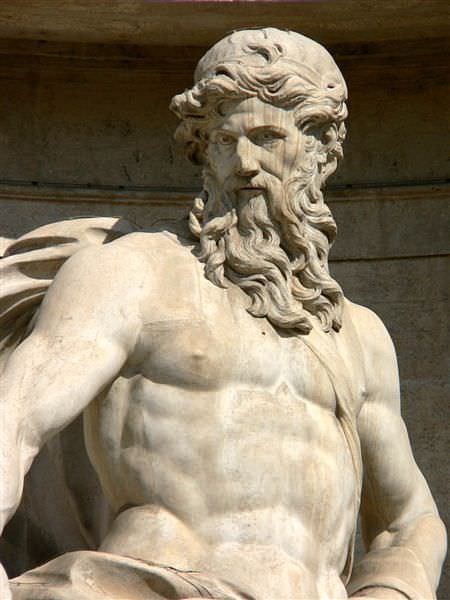
The Titan Oceanus
The side by side development in the presentation of myths was the creation of poems in Ionia and the celebrated poems of Homer and Hesiod around the 8th century BCE. For the first time mythology was presented in written form. Homer's Iliad recounts the last stages of the Trojan State of war - perhaps an amalgamation of many conflicts between Greeks and their eastern neighbours in the late Bronze Age (1800-1200 BCE) - and the Odyssey recounts the protracted voyage home of the hero Odysseus following the Trojan War. Hesiod's Theogony gives a genealogy of the gods, and his Works and Days describes the creation of human. Not only are gods described with typically human feelings and failings but also heroes are created, often with one divine parent and the other mortal, thus providing a link between man and the gods.
The side by side chief representation of myths was through pottery from the 8th century BCE onwards. A myriad of mythical scenes decorate ceramics of all shapes and function and must surely have spread the myths to a wider audience.
The Greeks created myths to explain just most every element of the human condition.
Greek mythology continued to be pop through the centuries, and major public buildings such every bit the Parthenon at Athens, the Temple of Zeus at Olympia, and the Temple to Apollo at Delphi were decorated with larger-than-life sculpture representing historic scenes from mythology. In the 5th century BCE the myths were presented in the new format of theatre, especially in the works of the three tragedians Aeschylus, Sophocles, and Euripides. At the same time, from the 6th century BCE the kickoff documented scepticism and even rejection of the myths began with the pre-Socratic philosophers who searched for a more scientific explanation for phenomena and events. Finally, in the 5th century BCE the first historians Herodotus and Thucydides sought to document every bit accurately equally possible and record for posterity a less subjective view of events and then the mod discipline of history was built-in.
Greek Myths - An Overview
Broadly speaking, the imaginative Greeks created myths to explain simply virtually every element of the human condition. The creation of the world is explained through ii stories where a son usurps the place of his father - Cronus from Ouranos and Zeus from Cronus - mayhap referring to the eternal struggle which exists between different generations and family members. The Olympian gods led past Zeus twice defeated the sources of chaos represented by the Titans and the Giants. These gods so, rule man's destiny and sometimes direct interfere - favourably or otherwise. Indeed, the view that events are non human being's to determine is further evidenced by the specific gods of Fate and Destiny. A further mythological explanation of the seemingly random nature of life is the blind god Pluto who randomly distributes wealth. The gods as well illustrated that misdemeanours would be punished, e.thousand., Prometheus for stealing burn and giving it to homo. The origin of other skills such equally medicine and music are also explained as 'divine' gifts, for example, Apollo passing on to his son Asklepios medicinal cognition for man's benefit. Finally, certain abstract concepts were too represented past specific gods, due east.yard., Justice (Dike), Peace (Eirene), and Lawfulness (Eunomia).

Gilded Statuary Hercules
The Heroes - the about famous being Hercules, Achilles, Jason, Perseus, and Theseus but including a bang-up many more - all have divine parents and therefore bridge the gap between mortals and gods. These pop heroes pursue fantastic adventures and epitomise ideal qualities such every bit perseverance e.grand., Hercules' twelve labours, or fidelity eastward.g., Penelope waiting faithfully for Odysseus' return. Heroes also added prestige to a metropolis by beingness credited as its founder, eastward.chiliad., Theseus for Athens, Perseus for Mycenae, or Kadmus for Thebes. The heroes and events such every bit the Trojan War also represented a past gold age when men were greater and life was easier. Heroes then were examples to aspire to, and by doing great deeds a certain immortality could exist reached, either absolutely (as in the case of Hercules) or through commemoration in myth and tradition.
In contrast, many mythological figures represent qualities to be avoided and their sad tales illustrate the dangers of bad behaviour. King Midas, for example, was granted his wish that everything he touched turned to gilded, only when he found out that this included food and drink, his forehandedness about resulted in his death from starvation and thirst. The myth of Narcissus symbolises the dangers of vanity after the poor youth fell in love with his own reflection and he lost the will to live. Finally, the story of Croesus warns that vast riches cannot guarantee happiness when the fabulously rich Male monarch misinterpreted the Delphic oracle and lost his kingdom to Persia.
Natural phenomena were explained with myth, e.one thousand., earthquakes are created when Poseidon crashes his trident to the ground or the passage of the sun is Helios in his chariot riding beyond the sky. Myths such as Persephone'southward half year descent to Hades explained the seasons. Time itself had mythological explanations: Helios' vii herds of 350 cattle correlate to the days of the yr, Selene's 50 daughters are the weeks, and Helios' twelve daughters the hours.
Greek mythology also includes a number of monsters and strange creatures such as the ane-eyed Cyclops in the Odysseus story, a gigantic boar in the fabled Kalydonian chase, sphinxes, giant snakes, fire-breathing bulls and more. These creatures may represent anarchy and lack of reason, for example, the centaurs - half-man and one-half-horse. Fierce and fantastic creatures often emphasise the difficulty of the tasks heroes are set, for example, the many-headed Hydra to be killed by Hercules, the gorgon Medusa whose look could turn yous into rock and whom Perseus had to behead, or the Chimera - a fire-animate mix of lion, goat and snake - which Bellerophon killed with the help of his winged-horse Pegasus. Alternatively, they may represent the other-worldliness of certain places, for example the three-headed dog Kerberos which guarded Hades or only symbolised the exotic wildlife of distant lands visited past Greek travellers.
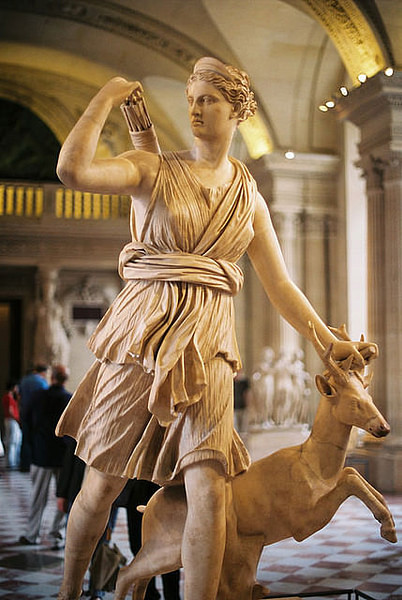
Artemis / Diana
Peradventure unfamiliar experiences were besides explained in myth, for instance, one can imagine that a Greek visiting King Minos' sophisticated and many-roomed palace at Knossos might have thought it a labyrinth, and the worship in that location of bulls and the sport of balderdash-leaping might be the source of the Minotaur - is information technology coincidence information technology was killed by the visiting Athenian, Theseus? Could Jason'due south expedition for the Aureate Fleece exist a reference to the rich gold of the Caucasus and a Greek expedition to plunder this resource? Exercise the Amazons represent an encounter with another culture where women were treated more as than in the Greek world? Exercise the Greek myths of the Sirens and Charybdis warn of the dangers of travel beyond familiar territory?
Such questions may well remain unanswered only starting with the discovery of Troy in the 19th century CE, archaeological finds have steadily contributed an ever-growing body of physical evidence which illustrates that the oral traditions and stories from Greek mythology had an origin and a purpose they were non previously credited with.
This article has been reviewed for accuracy, reliability and adherence to academic standards prior to publication.
Source: https://www.worldhistory.org/Greek_Mythology/
0 Response to "Why Do You Think Greek Myth Uses the Model of the Human Family to Depict the Gods?"
Post a Comment