Philadelphia Art Museum Copy Van Der Weyden Descent From Cross
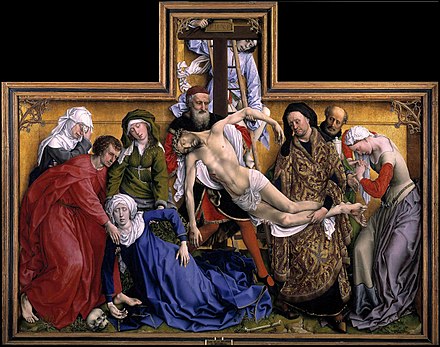
The Descent from the Cross c. 1435. Oil on oak panel, 220cm × 262 cm. Museo del Prado, Madrid
The Descent from the Cross (or Deposition of Christ , or Descent of Christ from the Cross ) is a panel painting by the Flemish creative person Rogier van der Weyden created c. 1435, now in the Museo del Prado, Madrid. The crucified Christ is lowered from the cantankerous, his lifeless trunk held past Joseph of Arimathea and Nicodemus.
The c. 1435 date is estimated based on the work's style, and considering the artist caused wealth and renown around this time, most likely from the prestige this master piece of work brought him.[1] Information technology was painted early in his career, presently after he completed his apprenticeship with Robert Campin and shows the older painter'due south influence, well-nigh notable in the hard sculpted surfaces, realistic facial features and brilliant main colours, mostly reds, whites and blues.[2] The work was a self-conscious attempt by van der Weyden to create a masterpiece that would establish an international reputation. Van der Weyden positioned Christ's body in the T-shape of a crossbow to reflect the commission from the Leuven guild of archers (Schutterij) for their chapel Onze-Lieve-Vrouw-van-Ginderbuiten ( Notre-Matriarch-hors-les-Murs ).
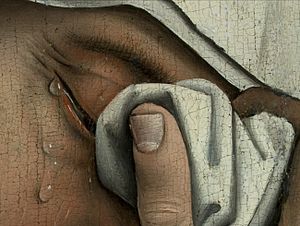
Art historians have commented that this piece of work was arguably the nigh influential Netherlandish painting of Christ's crucifixion, and that information technology was copied and adapted on a large scale in the two centuries afterwards its completion. The emotional impact of the weeping mourners grieving over Christ'due south body, and the subtle depiction of space in van der Weyden's piece of work take generated extensive critical comments, one of the virtually famous existence, that of Erwin Panofsky: "It may be said that the painted tear, a shining pearl born of the strongest emotion, epitomizes that which Italian most admired in Early Flemish painting: pictorial brilliance and sentiment".[three]
Description [edit]
In their accounts of the descent of Christ'southward body from the Cross, the evangelists relate the story only in connection with the Entombment of Christ. Co-ordinate to the canonical gospels, Joseph of Arimathea took Christ'due south body and prepared it for burial. John (19:38–42) adds one assistant, Nicodemus. None of these accounts mention Mary. During the Middle Ages, the narrative of the Passion became more elaborate, and more attention was paid to the office of Christ'southward female parent. One instance is the anonymous 14th-century text, Meditationes de Vita Christi, perhaps by Ludolph of Saxony. Barbara Lane suggests this passage from the Vita Christi might lie backside many paintings of the Deposition,[4] including Rogier'southward: "Then the lady reverently receives the hanging right paw and places information technology against her cheek gazes upon information technology, and kisses it with heavy tears and sorrowful sighs."

Mary of Clopas, Saint John the Evangelist and Mary Salome (according to Campbell)
In her history of the veneration of the Virgin Mary, Miri Rubin writes that in the early 15th-century artists began to draw the "Swoon of the Virgin" or Mary swooning at the foot of the cantankerous or at other moments, and that van der Weyden's Descent was the most influential painting to bear witness this moment. This swooning was described by theologians with the discussion spasimo.[5] In the early 16th century, such was the popularity of depictions of the swooning Virgin, Pope Julius Ii was lobbied with a request to designate a holy day as a banquet of the spasimo. The request was turned down.[6]
Art historian Lorne Campbell has identified the figures in the painting as (from left to correct): Mary Cleophas (one-half-sister to the Virgin Mary); John the Evangelist, Mary Salome (in green, some other half-sister of the Virgin Mary), The Virgin Mary (swooning), the corpse of Jesus Christ, Nicodemus (in red), a beau on the ladder – either a servant of Nicodemus or of Joseph of Arimathea, Joseph of Arimathea (in field-of-textile-of-gold robes, the virtually sumptuous costume in the painting), the bearded man behind Joseph holding a jar and probably another retainer[7] and Mary Magdalene who adopts a dramatic pose on the right of the painting.[viii]
There is disagreement betwixt art historians as to the representation of Joseph of Arimathea and Nicodemus. Dirk de Vos identifies Joseph of Arimathea as the homo in ruby-red supporting Christ'due south body, and Nicodemus as the human supporting Christ's legs, the opposite of Campbell's identification.[9]
Sources and mode [edit]
The work is unique in the period because of Mary's swoon; her collapse echoes the pose of her son, as far every bit to the 2 figures that hold her as she falls. This pose was entirely new for Early Netherlandish art.[10] The sentiment, however, is a direct reflection of the mystical devotion expressed by Thomas à Kempis' popular treatise The Faux of Christ, first published in 1418. The text, just as the image here, invites the reader or viewer to personally identify with the suffering of Christ and Mary. The doctrines of Denis the Carthusian besides emphasized the significance of the Virgin Mary and her belief in Christ at the moment of his expiry. Denis expresses the conviction that the Virgin Mary was near death when Christ gave upwards his spirit; Van der Weyden's painting powerfully conveys this idea.[11]

The Crucified Thief, Robert Campin, c. 1420–1440. Campin's sculptural style so influenced van der Weyden that at ane stage art historians thought they might have been the same person.[12]
The shape of the crossbow can be seen in the bent and contorted outline and bend of Christ's body and biconvex back, which seems to reverberate the patronage of the Greater Guild of Crossbowmen.[13] Powell argues that in medieval theology, a mutual metaphor compared the form of Christ on the cross to a taut crossbow: "[this] bow consists of a piece of wood or horn and a string, which represents our Saviour. The cord can represent his most holy trunk, which was miraculously strained and stretched in the suffering of his Passion."[14] The fourteenth-century poet, Heinrich von Neustadt, wrote: "He was laid out on the cross:/At that place were his pure limbs/and his arms fatigued/Like the string of a bow." In Rogier's Degradation, Christ's removal from the cantankerous is pictured as the relaxation of a bow that has released its arrow.[15]
Dirk de Vos suggests that van der Weyden wished to evoke a life sized, carved relief filled with polychrome figures, and thus drag his painting to the level of m scale sculpture. The work's corners are filled with carved gilded tracery, with the presentation of living figures on a stage intended as a tableau vivant, or sculptural group, the latter of which is created through the sense of condensed motion within a single instant. Mary faints and is supported past St John who rushes to her help. The man on the ladder lowers Christ'southward torso is already reinforced past Joseph of Arimathea and Nicodemus, both of whom seems to want to deport information technology to the right of the pictorial infinite. Nicodemus's move transforms the weeping Magdalene into a statue frozen in time. De Vos writes: "Time seems to have solidified into a composition. And what a composition. Interplay of undulating lines, swaying poses and counterposes of figures have rightly been compared to technique of counterpoint in polyphonic music."[xvi]


The epitome can be read as a petrified synthesis of all the stages during and afterwards the Descent from the Cantankerous: the lowering of the corpse, the Deposition, Lamentation and the Entombment. Christ'due south feet appear to be still nailed together, while the spread of His arms retains the position of His body on the Cantankerous. Christ's trunk is shown as if held out for the full-bodied gaze of the viewer. Joseph of Arimathea looks across the body towards the skull of Adam. Joseph appears as a sumptuously dressed burgher and has the most portrait-like appearance of the figures in the painting; his gaze links the easily of Christ and his female parent, the new Adam and Eve, with the skull of Adam. Thereby visualising the essence of the Redemption.[17]
De Vos also analyses the spatial complexity of the painting. The action takes place in a space barely a shoulder-width deep, nonetheless there are no fewer than five levels of depth within the painting: the Virgin Mary at the front, the torso of Christ, the bearded effigy of Joseph of Arimathea, the cross and the banana on his ladder. At the "dorsum" of the painting, the assistant breaks the spatial illusion, by allowing one of the two nails he holds to protrude in front of the painted niche.[18] Campbell argues that the cardinal to the work is non naturalism in the detail of the painting, just rather the utilize of distortion to induce a sense of unease in the viewer. By including completely irrational details and by distorting otherwise extremely faithful images of reality, the artist shocks us into reconsidering our attitudes to his subjects. Campbell suggests that, in certain aspects, Rogier has more in common with Matisse or the Picasso of Guernica than with his contemporaries.[eight]
An example of the play with the illusion of space can be seen in the young human being at the top of the ladder holding the nails withdrawn from Christ's torso. Campbell points out that this retainer behind the cross appears to accept caught his sleeve in the wooden tracery depicted at the pinnacle of the painting. The caput of one of the bloody nails that he holds is in front of the fictional wooden flick frame, though the point of the other boom is backside the tracery.[eight] Campbell argues that, in order to prevent these spatial distortion from becoming too obvious, Rogier took pains to conceal the principal pictorial junctions in the picture. For case, the ladder is in an impossible perspective: its height is behind the cross while its pes appears to be in front of the cross. To conceal the points at which the Cross and the ladder meet the landscape, Rogier has greatly diffuse the Virgin'south left leg, so that her left foot and curtain embrace the base of the Cantankerous and one upright of the ladder.[8]
Provenance [edit]

The painting was commissioned by the Greater Guild of Crossbowmen of Leuven and installed in the Chapel of Our Lady Without the Walls.[xix] [20] The tiny crossbows in the side spandrels of the picture reflect the original patronage.[21] De Vos and Campbell both give an approximate date of 1435 for the painting. De Vos argues that the earliest known copy of Van der Weyden's Degradation, the Edeleheere triptych in Leuwen, may have been completed by 1435, certainly before 1443. This implies that Van der Weyden'southward painting pre-dates it.[19] The painting was exchanged around 1548 for a re-create by Michael Coxcie and an organ. The new owner was Mary of Austria,[19] sister of Holy Roman Emperor, Charles V, for whom she governed the Habsburg Netherlands. The painting was initially installed in Mary's castle at Binche, where information technology was seen by a Castilian courtier, Vicente Alvárez, who in 1551 wrote "It was the best picture in the whole castle and even, I believe, in the whole globe, for I have seen in these parts many skillful paintings just none that equalled this in truth to nature or devoutness. All those who have seen it were of the same stance."[19]
Alvárez had accompanied the future male monarch of Espana, Philip II on his tour of his possessions in kingdom of the netherlands. After inheriting the Descent from his aunt Mary in 1558, Philip transported the painting to Spain, where it was installed in his hunting club, El Pardo.[19] On fifteen April 1574, the painting was recorded in the inventory of the monastery palace which Philip had founded, San Lorenzo de El Escorial: "A large panel on which is painted the deposition from the cantankerous, with our Lady and viii other figures ... by the hand of Maestre Rogier, which used to belong to the queen Mary".[22]
When Civil State of war broke out in Espana in 1936, many religious works of art were destroyed. The Spanish Republic took action to protect its artistic masterpieces; The Descent from the Cantankerous was evacuated from El Escorial to Valencia. It was brought to Switzerland by train in the summer of 1939, where the Castilian Republic publicised its plight with an exhibition: "Masterpieces of the Prado", held in the Musée d'Art et d'Histoire in Geneva. That September, the painting returned to the Prado, where information technology has since remained.[23] [24] Past 1992, the Descent was in a land of decay with cracks in the panel threatening to split the painting, and a marked deterioration of the paint surface. A major restoration of the painting was carried out past the Prado, under the supervision of George Bisacca from the Metropolitan Museum of Art, New York.[25]
Influence [edit]
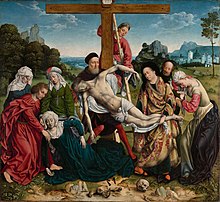
The work has been often copied and is extremely influential; within van der Weyden's ain lifetime it was considered an important and unique work of art.[27] In 1565, the Antwerp publisher Hieronymus Erect published an engraving by Cornelis Cort, the outset graphic reproduction of Rogier's Descent, which is inscribed with the words "M. Rogerij Belgiae inuentum". Cock'southward engraving is the earliest tape of Rogier'south name in association with the Deposition.[28]
In 1953 art historian Otto Von Simson claimed that "no other painting of its school has been copied or adapted so often".[29] In a 2010 episode of the BBC documentary series The Private Life of a Masterpiece which examined the history and influence of The Descent From The Cross, Professor Susie Nash of the Courtauld Institute of Art commented, "Information technology seems that the innovation that van der Weyden made were so striking that other artists throughout Europe, virtually could not get away from them. They are quoted once more and again and once more." Nash concluded, "I remember there's a very, very strong case to be fabricated that this is the most important painting of the whole period of the entire 15th century."[30] [31]
In January 2009 Google Earth's collaborative project with the Prado made twelve of its masterpieces, including Descent from the Cross, available at a resolution of xiv,000 megapixels, some ane,400 times greater than a movie taken on a standard digital photographic camera.[32]
References [edit]
Citations [edit]
- ^ Clark, 52
- ^ Clark, 47
- ^ Panofsky 1953, p. 258
- ^ Lane, Altars and Altarpieces, 89
- ^ Rubin, 314–315
- ^ Rubin, 362
- ^ the jar is likely an emblem of the Magdalen, containing the 'pound of ointment of spikenard, very costly', with which she all-powerful the feet of Jesus
- ^ a b c d Campbell, Lorne. "The New Pictorial Linguistic communication of Rogier van der Weyden", in Rogier van der Weyden, Master of Passions, ed. Campbell & Van der Stock, 2009. 2–64
- ^ De Vos, 21
- ^ Snyder, 118
- ^ von Simson, fourteen–fifteen.
- ^ Clark, 45
- ^ Powell, 544
- ^ Gottfried von Admont, " Arcus, qui ex ligno et chorda, vel cornu et chorda constat, eumdem Dominum ac Redemptorem nostrum nobiliter demonstrat. Potest enim designari per chordam sanctissima ejus caro, diversis tribulationum angustiis mirabiliter attracta atque distenta ". Patrologia Latina: The Full-Text Database, Alexandria, 1996, vol. 174, 1150A-B. Quoted and discussed in Frederick P. Pickering, Das gotische Christusbild: Zu den Quellen mittelalterlicher Passionsdarstellungen , Euphorion: Zeitschrift fur Literaturgeschichte , 47, 1953, 31–2.
- ^ Powell, (2006) The Errant Image: Rogier van der Weyden's Deposition from the Cantankerous and its Copies, 545
- ^ De Vos, 14–xvi
- ^ De Vos, 22
- ^ De Vos, 15
- ^ a b c d e De Vos, 185–186
- ^ "Descent from the Cross, Prado website". Retrieved 26 Dec 2010.
- ^ Snyder, Northern Renaissance, 118
- ^ Powell, (2006) The Errant Epitome: Rogier van der Weyden'southward Deposition from the Cross and its Copies, 552
- ^ Arte protegido/Protected Art, catalogue of exhibition at the Palais des Nations, Geneva, March–Apr 2005, published past Museo Nacional del Prado
- ^ Museo del Prado, Catálogo de las pinturas. Ministerio de Educación y Cultura, Madrid, 1996. 448. ISBN 84-87317-53-7
- ^ "Frames: The Northern European Tradition" (PDF). Artinitiatives. 2005-10-xviii. Archived from the original (PDF) on 2011-10-03. Retrieved 2010-08-23 .
- ^ Snyder, p. 418
- ^ von Simson, nine–10
- ^ Powell, (2006) The Errant Image: Rogier van der Weyden's Deposition from the Cross and its Copies, 550
- ^ von Simson, 9
- ^ Gilded, Mick (dir). The Private Life of an Easter Masterpiece: The Descent From the Cross. BBC2, 3 April 2010 (documentary)
- ^ "BBC Television set reflects on the true pregnant of Easter". BBC Printing Office. 2010-02-09. Retrieved 2011-01-17 .
- ^ Tremlett, Giles (2009-01-xiii). "Google brings masterpieces from Prado directly to armchair art lovers". The Guardian . Retrieved 2009-09-02 .
Sources [edit]
- Borchert, Till-Holger. Van Eych to Durer. London: Thames & Hudson, 2011. ISBN 978-0-500-23883-7
- Campbell, Lorne. The Fifteenth Century Netherlandish Paintings. National Gallery, 1998. ISBN 978-1-85709-171-vii
- Campbell, Lorne. Van der Weyden. London: Chaucer Printing, 2004. ISBN ane-904449-24-7
- Campbell, Lorne & Van der Stock, January, Rogier van der Weyden: 1400-1464. Master of Passions. Leuven: Davidsfonds, 2009. ISBN 978-ninety-8526-105-6.
- Clark, Kenneth. Looking at Pictures. New York: Holt Rinehart and Winston, 1960
- De Vos, Dirk. Rogier Van Der Weyden: The Complete Works. Harry North. Abrams, 1999. ISBN 0-8109-6390-half-dozen
- Lane, Barbara. The altar and the altarpiece: sacramental themes in early Netherlandish painting. Harper & Row, 1984. ISBN 0-06-435000-2
- Panofsky, Erwin. Early Netherlandish painting: Its Origins and Graphic symbol. Cambridge, MA: Harvard Academy Press, 1953.
- Powell, Amy. "The Errant Image: Rogier van der Weyden'southward Deposition from the Cross and its Copies". Art History, Vol. 29, No. 4. 540–552
- Rubin, Miri. Mother of God: A History of the Virgin Mary, Allen Lane, 2009, ISBN 0-7139-9818-0
- von Simson, Otto G., " Compassio and Co-redemption in Roger van der Weyden's Descent from the Cross". The Fine art Bulletin, Vol. 35, No. i, March, 1953. 9–xvi.
- Snyder, James, Northern Renaissance Fine art; Painting, Sculpture, The Graphic Arts from 1350 to 1575. Saddle River, NJ: Prentice Hall, 2005.
External links [edit]
| External video | |
|---|---|
 Van der Weyden's Deposition, Smarthistory at Khan Academy Van der Weyden's Deposition, Smarthistory at Khan Academy |
 Media related to Descent from the Cantankerous by Rogier van der Weyden (Prado) at Wikimedia Eatables
Source: https://en.wikipedia.org/wiki/The_Descent_from_the_Cross_%28van_der_Weyden%29
0 Response to "Philadelphia Art Museum Copy Van Der Weyden Descent From Cross"
Post a Comment