Why Is Net Neutrality Voting Again
Net neutrality fight continues —
Pai'south FCC squeezes in i more than vote against cyberspace neutrality before election
FCC reconfirms Title II repeal, says no changes needed despite courtroom remand.
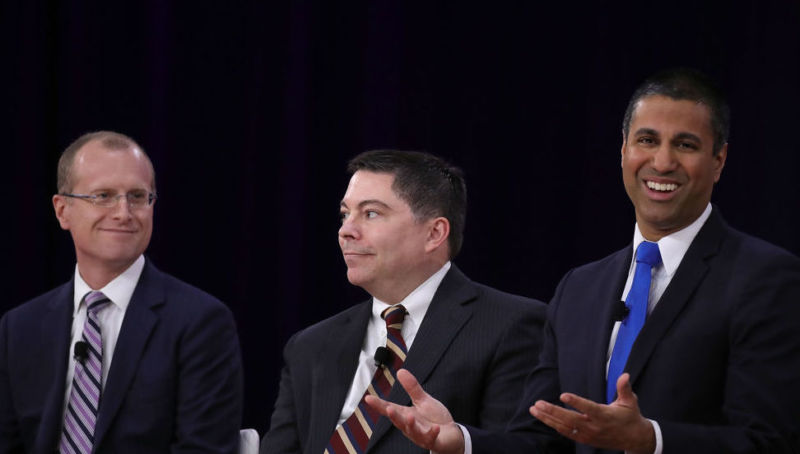
Enlarge / FCC Republican members (L-R) Brendan Carr, Michael O'Rielly, and Chairman Ajit Pai participate in a discussion during the Conservative Political Action Briefing on February 23, 2018, in Maryland.
The Republican-majority Federal Communications Commission took some other vote against net neutrality rules today in its last meeting before a presidential ballot that could swing the FCC back to the Autonomous Political party.
Today's vote came a yr after a federal appeals court upheld FCC Chairman Ajit Pai'south repeal of net neutrality rules and deregulation of the broadband manufacture. Though Pai was mostly victorious in the instance, the judges remanded portions of the repeal back to the FCC because the commission "failed to examine the implications of its decisions for public safety," failed to "sufficiently explain what reclassification [of ISPs] will hateful for regulation of pole attachments," and did not accost concerns near the effect deregulation would have on the FCC's Lifeline program, which subsidizes phone and Net access for low-income Americans.
The FCC approved its response to the court's remand instructions in a 3-2 vote today but didn't brand any significant changes. "After thoroughly reviewing the record compiled in response to its request for boosted comment on these problems, the FCC found no ground to alter the FCC's conclusions in the Restoring Internet Freedom Order," the commission said in its declaration. "The Order on Remand finds that the Restoring Internet Liberty Order promotes public safety, facilitates broadband infrastructure deployment by Internet service providers, and allows the FCC to continue to provide Lifeline back up for broadband Internet access service." A draft version of the decision is available here.
Democrats dissent, predict court failure for Pai
FCC Democrats Jessica Rosenworcel and Geoffrey Starks dissented today, saying the FCC bulk didn't provide a expert enough justification for sticking with the repeal as is. Rosenworcel chosen the gild "a prepare of 3 cobbled-together arguments designed to tell the court to go away, the public that we are non interested in their stance, and history that we lack the humility to admit our error." Starks said he doubts that the FCC's response to the remand will satisfy judges at the United states Court of Appeals for the District of Columbia Circuit, which could take up the case once again if the FCC faces another lawsuit.
The FCC bulk claimed that "regulatory certainty," meaning deregulation, results in increased innovation and investment that "will enhance public safety." The FCC likewise said the repeal "is unlikely to harm public safety communications" and that any impact "would exist limited because broadband Net access service, while of import, is only a part of the broader public safety communications ecosystem." While the FCC gave up its Title II dominance over broadband providers, the commission claims that antitrust and consumer-protection laws enforced by other regulators will ensure that public safety agencies have advisable admission to communications services.
That wasn't good enough for Commissioner Rosenworcel. She said:
The very beginning sentence of the Communications Human activity tasks the FCC with "promoting safe of life and property." In other words, public safe is cardinal to our mission. But the agency disregards it here and sidesteps the concerns of the court by insisting that removing internet neutrality increases network investment, which will accrue to the do good of public condom. The evidence for this is less than clear. But more than importantly, it doesn't fairly explicate why this is the case when lives are on the line. Nor does it item in whatsoever meaningful way how commencement responders will manage when emergency communications are throttled or blocked. This concern is not just theoretical. Among those opposing the FCC's rollback of net neutrality are firefighters who establish their service throttled when they were responding to a raging blaze. But here their fears are given brusk shrift. The bureau but concludes that the emptying of cyberspace neutrality is worth the risk, even when lives are at stake. This is irresponsible.
Pai argued that "there is no show the Restoring Cyberspace Liberty order has harmed public condom. By employing a light-touch, marketplace-driven approach to regulation, broadband providers are amend able to build stronger and more resilient networks that enhance public safe, including through services similar next-generation 911."
If Democratic nominee Joe Biden defeats President Trump in the presidential ballot, he'll be able to appoint a chair to replace Pai and grade a Democratic majority that could reinstate net neutrality rules and Championship Ii regulation of broadband providers.
ISPs lost legal protections
The FCC'south reclassification of broadband, irresolute it from a common-carrier telecommunication service to an information service, removed some legal protections for Internet providers. Starks said this is a trouble for broadband-but providers that need access to utility poles to aggrandize their networks, and he added that the FCC remand ignores this:
The Remand Society acknowledges that admission to these poles is a "competitive bottleneck," and observes that cable operators, wireless Internet service providers and others accept filled the tape with stories almost the difficulties in obtaining reasonable access to poles. Still, the Remand Gild finds that reclassification does not significantly limit new entrants to the market place, and in an exercise in circular reasoning, simply restates the RIF [Restoring Internet Freedom] Social club'south claim that most ISPs will remain entitled to FCC protection considering their broadband service volition come bundled with Title II or cable services. Every bit for broadband-only ISPs, the Remand Social club blithely suggests that they could receive FCC protection if they simply began providing video or telecom services, notwithstanding their own business plans or financial circumstances... I neglect to see how such a response will satisfy the DC Circuit.
There'south a similar problem for companies that provide broadband service to poor people with subsidies from the FCC's Lifeline program, Starks said. "In response to the DC Excursion, the majority engages in a strained legal reading to notice that a provider may continue to receive Lifeline support for broadband service as long every bit that provider remains an Eligible Telecommunications Carrier offering telecom services to some customers," Starks said. "This would be tricky on its own terms, simply voice service in the Lifeline program will be phased out next year. What volition happen to Lifeline providers who may not have whatsoever remaining voice customers subsequently the phase-out?"
The FCC's bulk decision conceded that Lifeline support for broadband could be threatened, though it called such an outcome unlikely and said that "the benefits of reclassification would outweigh the removal of broadband Net access service from the Lifeline programme."
Pai today pointed out that, when the Obama-era FCC added broadband to the Lifeline programme, broadband was not however classified as a Title II common-carrier service. "It is the common-carrier status of the provider, not the service, that governs whether the provider is eligible to receive Lifeline back up for services provided over its network," Pai said. "If a common carrier offers voice service and qualifies as an ETC [eligible telecommunications provider], the Lifeline program tin can support affordable broadband Net access and service."
Fight to protect net neutrality "will continue"
Today'due south remand response did not address preemption of land internet neutrality laws. The FCC tried to preempt all such laws, but final yr'due south court decision said the commission cannot do that. An ongoing court case will decide whether California'southward net neutrality police force tin be enforced.
The remand society could exist met with lawsuits from some of the aforementioned advancement groups, state attorneys full general, and tech companies that previously challenged the repeal. "This remand gild callously dismisses the valid concerns of public safety officials, competitive broadband providers and millions of disconnected low-income families who can't afford to get online," Free Press Policy Manager Dana Floberg said. "But Pai goes fifty-fifty further, insisting that if the agency's decisions on these issues impairment these constituencies, that harm is justified by the supposed benefits of repealing Championship II."
Free Press, one of the FCC's opponents in the net neutrality court example, criticized Pai for claiming that the repeal spurred new broadband development. "Approximately 92 percent of the cobweb deployments made during Pai'south chairmanship were actually planned and announced during the last few years of the Obama administration, when Title II was securely in place," Floberg said. "Chairman Pai is trading away critical public protections for a bag of magic beans, and a flash and a nod from cable lobbyists. Nosotros need public servants who will really listen to people, consider the information and serve community needs instead of long-debunked ideologies."
Public Knowledge, some other advancement group that fought the repeal, said the fight will go along. "Ironically, the FCC is now claiming sweeping potency over social media and other online platforms without a legitimate legal basis—after claiming it has no authority to regulate broadband, which clearly falls under the agency's traditional telecommunications jurisdiction," Public Knowledge Legal Director John Bergmayer said, referring to Pai helping Trump impose a crackdown on Twitter and Facebook. "Nevertheless, the fight to protect net neutrality and promote good broadband policy is not over, and Public Knowledge will proceed to engage in that fight."
Source: https://arstechnica.com/tech-policy/2020/10/pais-fcc-squeezes-in-one-more-vote-against-net-neutrality-before-election/
0 Response to "Why Is Net Neutrality Voting Again"
Post a Comment